
OptumRx Specialty Pharmacy
Industry: Healthcare
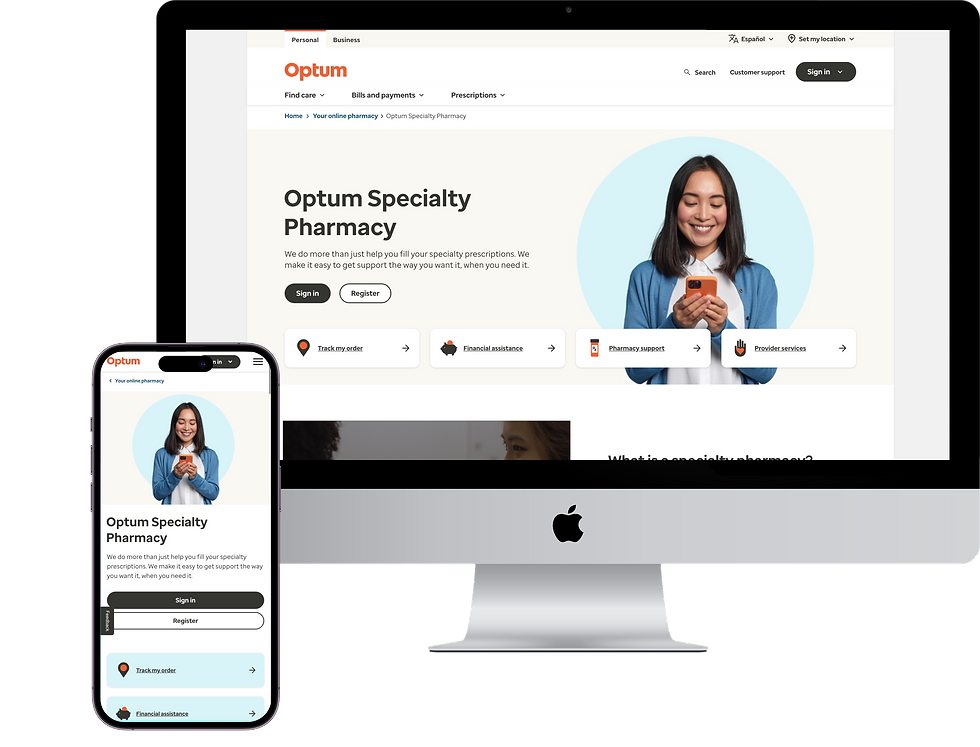
OptumRx Specialty Pharmacy supports patients with complex, rare, and chronic conditions by dispensing high-cost, tightly managed medications and delivering condition-specific pharmacist support (cancer, MS, RA, etc.). The engagement redesigned the patient and provider platform to simplify workflows, improve cross-device usability, and reduce operational friction across patient, clinician, and payer touchpoints.
APPROACH
-
Stakeholder workshops: aligned clinical leads, healthcare leads, compliance, and product owners on goals, success metrics, and constraints.
-
User interviews & contextual inquiry: conducted surveys with patients and interviewed prescribers and healthcare agents to map end‑to‑end journeys, pain points (prior auth delays, confusing status), and device contexts (tablet use in clinics, mobile while traveling).
-
Workflow mapping: documented authorization, dispensing, training, and monitoring touchpoints to reduce handoffs and surface required data early.
-
Iterative delivery: prioritized high-impact flows (referral/prescription intake, prior authorization, patient onboarding, shipment tracking) across sprints with continuous usability testing.
-
Close Ops collaboration: coordinated with fulfillment, clinical, and support teams for acceptance testing and to tune status labels and notifications.
DESIGN HIGHLIGHTS
-
Responsive, role-tailored interfaces: simplified patient portal for status/tracking and education; clinician view for quick prior-auth inputs and prescription history; agent dashboard for queue triage and verification.
-
Streamlined intake & prior authorization: reduced required fields via progressive disclosure, templated clinical questions, and pre-fill from Electronic Health Record integrations where available.
-
Clear status & escalation UI: unified order timeline, required actions, expected dates, and in-app alerts to reduce ambiguity and support asynchronous workflows.
RESULT
-
Reduced inbound support volume as users could self-serve status, tracking, and education—fewer basic calls to customer support.
-
Increased digital checkout/fulfillment rate due to clearer intake flows, fewer missing fields, and faster prior‑auth completion.
-
Faster triage and processing for agents from prioritized queues and standardized verification checklists.
-
Improved patient experience with clearer timelines, training resources, and reduced uncertainty around deliveries.


CHALLENGES
-
Simplify and clarify user flows for multiple user types (policyholders/patients, prescribers/clinicians, and healthcare agents) with differing goals and compliance needs.
-
Make the platform fully responsive and usable on tablets and mobile devices used in clinical and field settings.
-
Preserve strict privacy/security, integrate clinical documentation/workflows, and support complex fulfillment rules (cold-chain, training, prior authorization).
-
Reduce customer support load and speed up patient access to therapy while maintaining clinician control and auditability.
MY ROLE
-
Senior UX Designer: conducted research, interviews, interaction design, and prototyping focused on clinical and patient workflows.
-
Scrum Master: ran sprint planning, facilitated cross-functional ceremonies, and aligned stakeholders for iterative delivery.
